FAQ
Where in my vicinity can I buy TÊTE DE MOINE and the Girolle?
TÊTE DE MOINE is available in most supermarkets and - depending on the area - cheese counters or dairies and the «Girolle®» can often be purchased there as well. Click on the link buy TÊTE DE MOINE to get addresses and information as to online shopping.
How is TÊTE DE MOINE best stored?
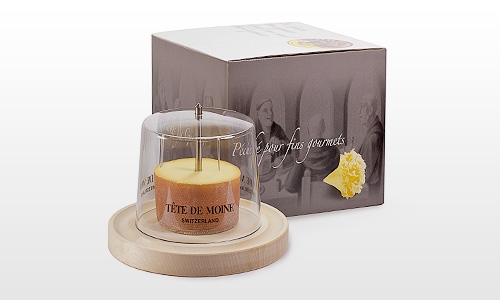
TÊTE DE MOINE, Bellelay cheese is best kept chilled under a cheese cover. More information
Why should TÊTE DE MOINE be pared instead of cut?
The ability to be pared is the special feature of TÊTE DE MOINE, and only pared rosettes offer a real treat for both your palate and eye. More information
How are rosettes created?
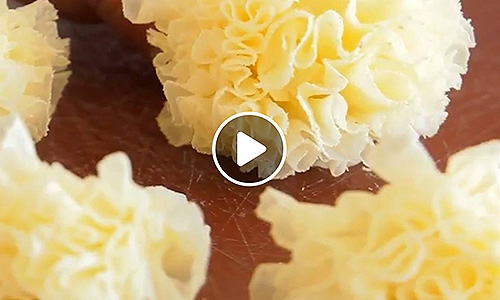
Rosettes may be created by paring the cheese with a knife held upright or - much easier - with a paring device like the «Girolle®». More information
How is TÊTE DE MOINE made?
TÊTE DE MOINE is made from untreated mountain milk of cows fed on silage-free fodder. The milk is processed on a daily basis within the region of origin (AOC) in the Swiss Jura; later the cheese is matured for at least 3 month in the area of origin. More information
Why is raw milk used to produce TÊTE DE MOINE?
Pasteurising destroys the natural microflora of the milk. Using unpasteurised (raw) milk from the AOC region ensures that its characteristic taste and flavour are fully preserved, and is a prerequisite for the production of this cheese with its unique aroma. More information on TÊTE DE MOINE milk
How long is TÊTE DE MOINE matured?
According to the AOC specifications TÊTE DE MOINE has to mature on pine boards for at least 3 months. Only cheese which complies with this requirement and passes stringent quality tests may be bestowed with the designation TÊTE DE MOINE. More information about maturing
How many cheese dairies produce TÊTE DE MOINE?
To date TÊTE DE MOINE is produced in 9 village dairies. Further information about those cheese dairies
What does the AOC registration signify?
AOC (Appellation d'origine contrôlée, or: protected designation of origin) guarantees that each TÊTE DE MOINE is a genuine cheese from the mountainous area of the Swiss Jura defined in the specifications, produced according to traditional methods and submitted to strict quality controls.
AOC also protects cheese-makers from imitation products and the designation substantially contributes to the economic prosperity of those rural communities. Traditional cheese making allows farmers, cheese-makers and other parties involved to make a living within the area and thus prevents migration. More information
What does AOC signify for TÊTE DE MOINE in particular?
On 19 January 2001 TÊTE DE MOINE was the second Swiss cheese to receive the AOC (protected designation of origin). In order to obtain this protection the production region and traditional cheese making methods have to be defined in a specification file and approved by Interprofession. More information
Where is TÊTE DE MOINE made?
The protected region of origin (AOC) for TÊTE DE MOINE is situated in the Swiss Jura. The cheese may only be made in the mountainous area and associated summering pastures (= mountain area) of the districts of Franches Montagnes, Porrentruy, the municipality of Saulcy and the land owned by the cheese dairy at Courgenay in the Canton of Jura and in the districts of Moutier and Courtelary in the Bernese Jura. Map and more information
Why may TÊTE DE MOINE only be made within the region of origin?
The production within the region of origin is one of the prerequisites for the AOC registration of a product. A product is characterised by the manifold influences within the region of origin: the climate, properties of the soil and consequently the range of plants as well as their frequency on the pastures, human factors like the knowledge of traditional production methods in the region of origin. All of those factors create the identify of TÊTE DE MOINE and its incomparable taste. More information
How is the quality of TÊTE DE MOINE tested?
The AOC specifications stipulate that regular quality controls be done. The cheese produced by each dairy is checked on a monthly basis by tests which comprise various assessment criteria. The designation TÊTE DE MOINE may only be attributed to cheese which has passed stringent quality testing.
More information about this test
How is the compliance with the AOC specifications ensured?
The compliance with the AOC specifications is monitored by the Intercantonal Certification Body, an independent and impartial organisation.
When and how is TÊTE DE MOINE best savoured?
As a cheese speciality TÊTE DE MOINE goes particularly well with aperitifs, buffets either on its own or on cheese assortment platters. Using the Girolle to pare away rosettes is a highlight in itself. Those delicate rosettes make an ideal salad garnish or may be served as a dessert together with nuts, figs or grapes. In earlier times TÊTE DE MOINE was often eaten with cumin.
When was TÊTE DE MOINE first made?
The origins of TÊTE DE MOINE date back to the 12th century. In 1192 the monks of Bellelay were first mentioned in connection with the cheese, so TÊTE DE MOINE is, in fact, much older than the Confederation of Switzerland!
Further information about the history of TÊTE DE MOINE
What are the nutritional values of TÊTE DE MOINE?
100 g of TÊTE DE MOINE consist of 35 g of water, 25 g of protein, 35 g of milk fat (or 51% in dry matter), 4 g of minerals and correspond to 1720 kJ or 419 kcal, respectively. More information
Does TÊTE DE MOINE contain any lactose or gluten?
No, it does not. Most of the lactose is dissolved in the whey, and the remainder is converted to lactic acid during the ripening process.
TÊTE DE MOINE is free of gluten.
|