Historical notes
TÊTE DE MOINE as a proper term has been used since about 1790, but the cheese has a much longer
history. The monastery of Bellelay was established in 1136 and confirmed by Pope Innozenz
II six years later. As early as 1192, or one century before the beginnings of the Swiss
Confederation, the monks of the monastery Bellelay were first mentioned in connection with
cheese. At that time they paid the annual rent on various properties with cheese made in
their abbey. Time and again documents from subsequent centuries mention the use of the
valuable cheese as a means of payment.
The oldest description of the Bellelay cheese dates from
1628 and states that a "very fatty milk of impeccable quality from the best grasses and
herbs of the country is used".
Source: Brochure of Guido Burkhalter, Der Bellelay Käse (TÊTE DE MOINE) und sein Ursprungsgebiet,
Schaffhausen, Kühn, 1979, page 16)
During the French Revolution the monks were evicted from the monastery in 1797, but the cheese
was still produced in the Royal cheese dairies of the former abbey. By the mid-19th century a
farmer from Bellelay, A. Hofstetter, succeeded in boosting production anew when his cheese received
awards at the "Concours Universel" of Paris in 1856 and at other trade fairs. Towards the end of
the 19th century several village cheese dairies were established. About 10 tons of TÊTE DE MOINE were exported
to as far away countries as Russia. At the beginning of the 20th century the making of the
cheese gradually shifted from the farms to the village dairies, and by 1950 the annual
production had increased to 27,000 kg.
The founding of the cheese trade organisation
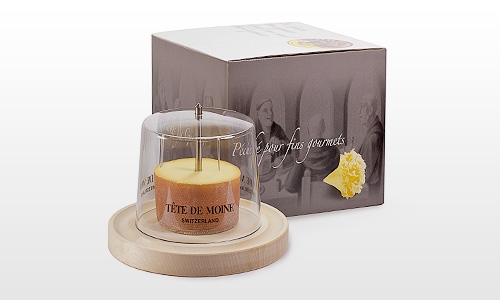
in the 70ties and the invention of the «Girolle®» in 1981 mark another turning point in the history of TÊTE DE MOINE.
|